
Best GPS Tracking Devices for Fleet Vehicles
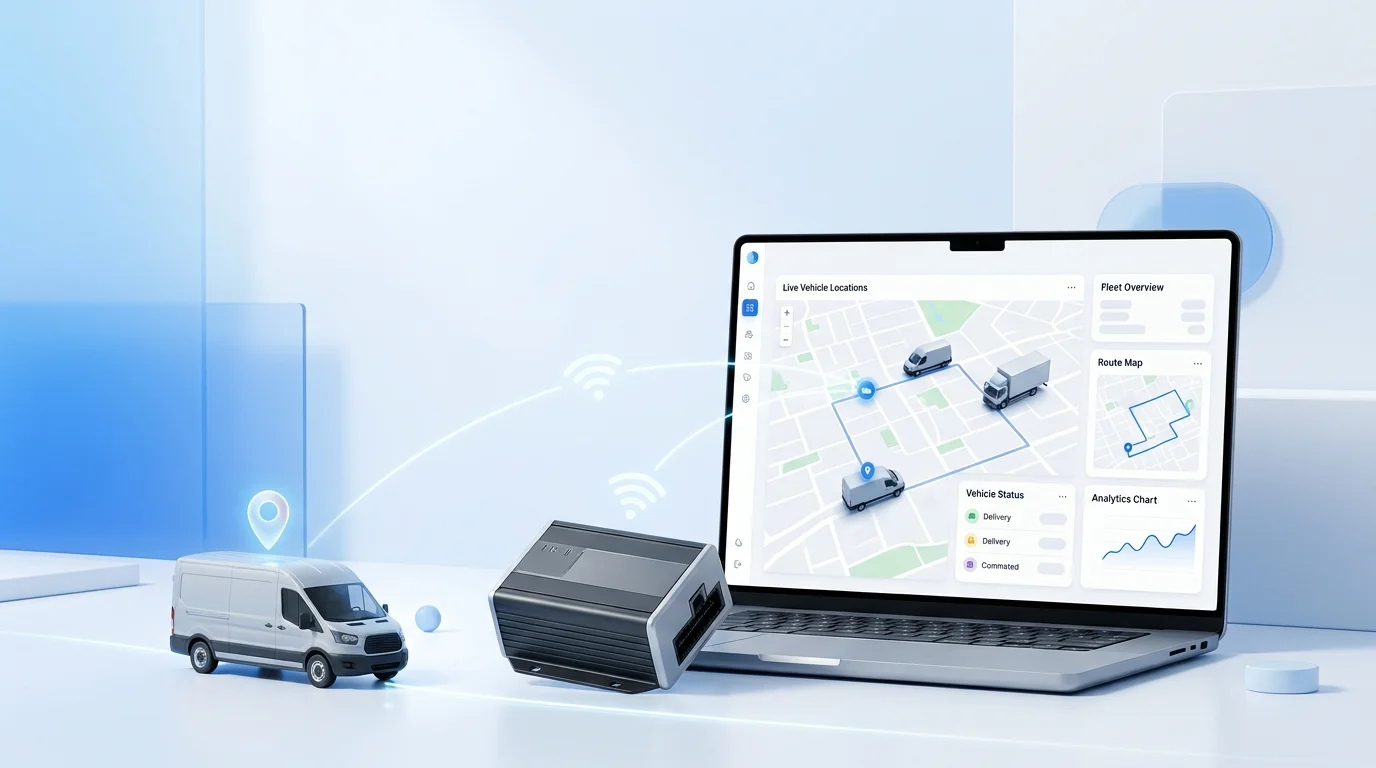
What the best GPS tracking device for a fleet car is really depends on the car and the job, rather than the brand. OBD plug-in trackers fit today’s light vehicles and can be installed in less than a minute. The hardwired trackers are designed for older models, high dollar vehicles or if the vehicle is easily tampered with. Trackers with batteries on trailers & equipment where there is no power source. Anticipate a $89-$150+ per device hardware fee, plus a $15-$50 monthly fee per device for the software. The most frequent purchasing error is to pay too much for cell phone plans that are not necessary.
Key Takeaways
- Purchase a device for $89 to $150 in total or $0 leased, and pay $15 to $50 per device per month for software.
- Essential features: multi-constellation GNSS, LTE 4G (LTE-M/NB-IoT for assets) and configurable update rate.
- Mixed fleets require mixed devices – OBD on modern vans, hardwired on trucks, battery on trailers – sensors often accompany all of these.
Mixed fleets require mixed devices – OBD on modern vans, hardwired on trucks, battery on trailers – sensors often accompany all of these. For how the technology works, see GPS tracking devices and hardware explained and how GPS tracking works.
Which Device Should You Choose?
All the majority of purchases begin here: when they select a single device type for an entire mixed fleet. Instead, use work on the job and match the device (and its sensors) to the asset.
| If You Need… | Recommended Device | Why |
| Passenger cars, light vans (1996+) | OBD tracker | Under-a-minute install, reads vehicle diagnostics |
| Heavy trucks, older vehicles | Hardwired tracker | Works on any 9–90V system, no OBD port needed |
| High-value or theft-prone vehicles | Hardwired (hidden) | Tamper-resistant; can’t be casually unplugged |
| Trailers and containers | Battery tracker | No power source required; magnetic mount |
| Construction equipment | Battery + engine-hour sensors | Utilisation data drives predictive maintenance |
| Cold chain / reefer | Hardwired + temperature sensor | Compliance evidence, not just location |
| School buses / passenger transport | Hardwired + panic button | Safety escalation alongside tracking |
| Fuel-sensitive operations | Hardwired + fuel-level sensor | Detects theft and siphoning |
| Tools, small equipment | Asset tags / Bluetooth | Low cost per unit; location, not live tracking |
The vast majority of the budget is saved by two rules. The answer is often a device plus a sensor – location alone is not usually reason enough for a rollout – it’s engine hours, temperature, or fuel level that make location into fleet telematics you can act on. Second, deploy cellular trackers on only assets that require real-time visibility or compliance, and battery/tag based devices on all other assets. The biggest waste of hardware budgets comes from paying full cellular rates on each trailer/ tool cart.
Which GPS Tracker Manufacturers Should You Consider?
Most trackers sold globally are manufactured by a limited number of specialist manufacturers, and understanding who they are enables you to make like-for-like comparisons – and to avoid unsupported unbranded trackers. The names are always the same with industry hardware rankings .
| Manufacturer | Base | Known For | Common Fleet Models |
| Teltonika | Lithuania | Broad catalog, configurability, strong support | FMB920, FMB130, FMC130 |
| Jimi IoT (Concox) | China | High volume, easy deployment, wide availability | GT06N, OB22, VL502, LL302 |
| Queclink | China | Industrial-grade, rugged asset and CAN devices | GV55W, GV300W, GL320MG |
| Ruptela | Lithuania | Fleet-focused telematics, CAN and fuel data | FM-Eco4, FM-Pro4 |
| Suntech (ST SUNLAB) | Brazil/China | Stability in long-running deployments | ST4340, ST940 |
| SEEWORLD | China | Cost-effective vehicle and asset devices | S116 |
| iStartek, WanWayTech, Coban | China | Budget and OEM/ODM options | Varies |
| Howen, Streamax | China | Video telematics and MDVR dashcams | Varies |
In practice: teltonika is the preferred choice for mixed fleets that require configurability and well-developed documentation; Jimi IoT (Concox) is the preferred choice for volume and simplicity (GT06N has been deployed for more than a decade and units are easily moved from one vehicle to another, which suits the leasing industry); Queclink is the preferred choice for rugged applications and asset tracking; Ruptela for CAN-bus and fuel data; and Suntech and SEEWORLD for cost-effective, no-frills stability. Most of these manufacturers also provide OEM/ODM programmes, if you wish to have custom firmware or own branding on the hardware, or if you require volume pricing as in many cases you may be a reseller using the hardware under your own brand.
A Word on Protocol Compatibility
This is the reason manufacturer choice is important: each manufacturer uses a different protocol for communication. Teltonika devices communicate the Teltonika protocol, Jimi IoT devices the GT06 protocol, and so forth. The tracking software must be able to handle that protocol to read the data.
Platforms with a wide variety of protocol support allow you to blend manufacturers, purchase on price or availability, and change suppliers down the road without having to change software. Platforms which are associated with proprietary hardware don’t. Before purchasing devices in bulk, it is important to find out which manufacturers and models are compatible with your chosen platform.
Must-Have Specs in 2026
Spec sheets are noisy. These are the ones that actually change day-to-day performance:
- Multi-constellation GNSS. GPS and GLONASS, Galileo, BeiDou reading devices will have quicker fixes and greater accuracy in urban environments, sometimes less than 3 metres.
- 4G LTE connectivity (and LTE-M/NB-IoT for assets). There is no more 3G, but 4G LTE-M and NB-IoT are of interest for low-power asset devices requiring years of battery life.
- Configurable update rate. For live dispatch: Every 10-60 seconds, for parked assets: slower. This single setting is the combination of usefulness and battery life.
- Ignition and engine data. Tracking turns into maintenance planning with engine hours, fuel and fault codes, and CAN-bus support reads vehicle diagnostics directly from the engine computer.
- ELD compatibility. If you are operating commercial vehicles, which are regulated, make sure that the device is compliant with the electronic logging requirements in your area before you purchase it.
- Sensor inputs. Cold Chain temperature & door sensors, engine-hour data for GPS equipment asset tracking.
- Tamper and power-cut alerts. Tamper and power-cut alerts. It’s essential when it comes to security from theft and being aware of when it’s been unplugged.
- Protocol openness. A device with a widely accepted protocol makes it easier to switch software at a later stage, hardware and software are not linked and a device bound to one platform constrains you.
An Illustrative Scenario
To understand this, let’s assume that, in a logistics operation, you have 250 vehicles, and you are starting with the assumption that there is one tracker of each type throughout the fleet.
The mix, however, changes when working through the matrix, as a company car uses OBD trackers (fast, tool-free installation); the truck uses hardwired trackers (tamper-proof, CAN-bus vehicle diagnostics); and the unpowered trailer uses battery-powered trackers. Dispatchers oversee all three types of devices from one device-agnostic platform, regardless of the brands of the devices.
The result: reduced installation expense, improved visibility of assets that require it and flexibility to switch hardware vendors after installation without needing to replace the tracking software. Although it’s a simple example, it illustrates typical fleet mix situations when purchasing hardware when no longer seeking a single “universal” hardware solution.
What GPS Tracking Devices Actually Cost
There are two costs to fleet tracking and they are the two that the buyer might consider.
| Cost Component | Typical 2026 Range | Notes |
| Device hardware (purchased) | $89–$150+ per device | Rugged/asset devices cost more |
| Device hardware (leased) | $0 upfront | Rolled into a longer contract |
| Software subscription | $15–$50 per device/month | Premium fleet plans $25–$45 |
| Professional installation | $75–$150 per vehicle | Mainly for hardwired units |
| Contract term | 12–36 months typical | Multiplies the true commitment |
The numbers to consider are: $99 device and $30/month plan on a 36 month term, which is about $1179 per vehicle over the course of the contract, and the hardware is the least of your problems. Ask for a 30–50% discount on monthly charges with annual billing.
That’s about $59,000 over three years for a 50 vehicle fleet, so larger fleets are more likely to consider software models where costs per vehicle aren’t a concern. Let’s take a look at one-time license vs subscription GPS tracking.
Buying Mistakes to Avoid
Five patterns come up repeatedly:
- Judging by sticker price. Subscription is for life, hardware is one time. Compare the 3 year total cost.
- Trusting battery specs at face value.A “5-year battery” refers to a battery with a specific update schedule. Ask what percentage that is of the population.
- Buying one device type for everything. Mixed fleets require mixed hardware, otherwise, the costs of trying to integrate OBD onto older trucks or cellular onto every tool cart are lost.
- Ignoring hardware lock-in. When this is the case, later software updates will necessitate hardware changes as well.
- Overlooking installation. Hardwired units require 15-30 minutes per vehicle, and they’ll usually need a professional to do the job – and pay the bill.
Installation: What to Plan For
Installation is the part that surprises fleets mid-rollout.
OBD plug-in can be done in about 30 seconds per vehicle, with no tools required, and requires no training at all. Perfect for quick deployment and turnaround vehicles.
Hardwired: 15-30 minutes per vehicle, typically a professional installation, using a three wire connection (power, ground, and ignition). Be mindful of the staggered nature of vehicle removal, don’t have all vehicles removed at once.
Battery-powered: effectively zero install, place and go, but plan a cycle of re-charging or replacing things you don’t see very often.
Realistic time for a 50-vehicle mixed fleet: one to two weeks – same-day OBD units and hardwired installs by vehicle availability.
Don’t Forget the Software
There’s an obvious risk of going through weeks of comparison and end up on whatever platform the hardware vendor provides. That’s the wrong way around: The device generates coordinates, but the software does all the rest, including creating geofencing, making predictions based on engine hours, tracking fuel usage, writing driver scorecards, reporting engine faults and analyzing fleets. Your tracker is the source of the raw signal, the platform determines what is useful and where your fleet information resides.
There are two things to consider. First, device-agnosticism: supporting a wide variety of GPS protocols, Teltonika, Jimi IoT (Concox), Queclink, Ruptela and more, you can purchase on price or availability, and there is no need to change systems. Second, where the data is stored: on the vendor’s cloud with a recurring charge per vehicle.
AIQ Connect does the opposite: the solution is self-hosted, device agnostic and is a one-time license, meaning tracking information remains on your own server and vehicle subscription doesn’t involve software costs. For a fleet with more than a few dozen vehicles or for fleet with sensitive route data, that is often more important than which tracker they can bolt in, although a very small fleet with a demand for a bundled plug-and-play package may want a cloud package. Check out what is self-hosted GPS tracking software or compare platforms in best GPS fleet tracking systems.
Related Reading
- How GPS Tracking Works
- Geofencing Explained
- What Is Fleet Tracking Software?
- How Fleet Maintenance Software Reduces Costs
- AI in Fleet Management
- What Is White-Label GPS Tracking Software?
- One-Time vs Subscription GPS Tracking
Frequently Asked Questions
What is the best GPS tracking device for fleet vehicles?
There is no single optimum device for all fleets. OBD plug-in trackers fit modern light vehicles and take less than a minute to install; hardwired trackers fit older vehicles or vehicles that are prone to theft and are tamper-proof; and battery-powered trackers fit trailers and equipment that are not powered. A combination is used by most mixed fleets.
How much do fleet GPS tracking devices cost?
The price of the hardware is usually $89- $150 per unit, or $0 if leased for the long term. Installed software subscription is $15-$50 per device per month (with a premium subscription rate at $25-$45 per month for fleet plans). Hardwired installation is $75-$150 per vehicle for professional installation.
What specs matter most in a fleet GPS tracker?
Multi-constellation GNSS for accurate data, 4G LTE connectivity (LTE-M and NB-IoT for battery assets), an adjustable update rate, engine and ignition data on powered vehicles, ELD support if you operate regulated vehicles, tamper alerts, and extensive compatibility with various protocols.
Who are the main GPS tracker manufacturers, and does the maker affect my software choice?
The most widely used are Teltonika, Jimi IoT (Concox), Queclink, Ruptela, and Suntech, whereas SEEWORLD, iStartek and Coban are common in budget and OEM. Yes the maker does, each has their own protocol and your platform must support it (Teltonika’s own protocol or the GT06 protocol for the Jimi IoT devices). Wide protocol compatibility allows you to integrate manufacturers and use different suppliers without having to replace your system.
How long does GPS tracker installation take?
OBD plug-in devices will require around 30 seconds to install, using no tools. Hardwired units require 15-30 minutes per vehicle and typically require a professional. No installation required with battery-powered trackers. A 50 vehicle mixed fleet takes about a week or two into the field.
Do GPS trackers work on trailers and equipment without power?
Yes, battery powered trackers, frequently with magnetic mounts. The number of quoted weeks to several years of battery life may assume a different update rate; be sure to check which.


