
Self-Hosted vs Cloud GPS Tracking for Fleet Management
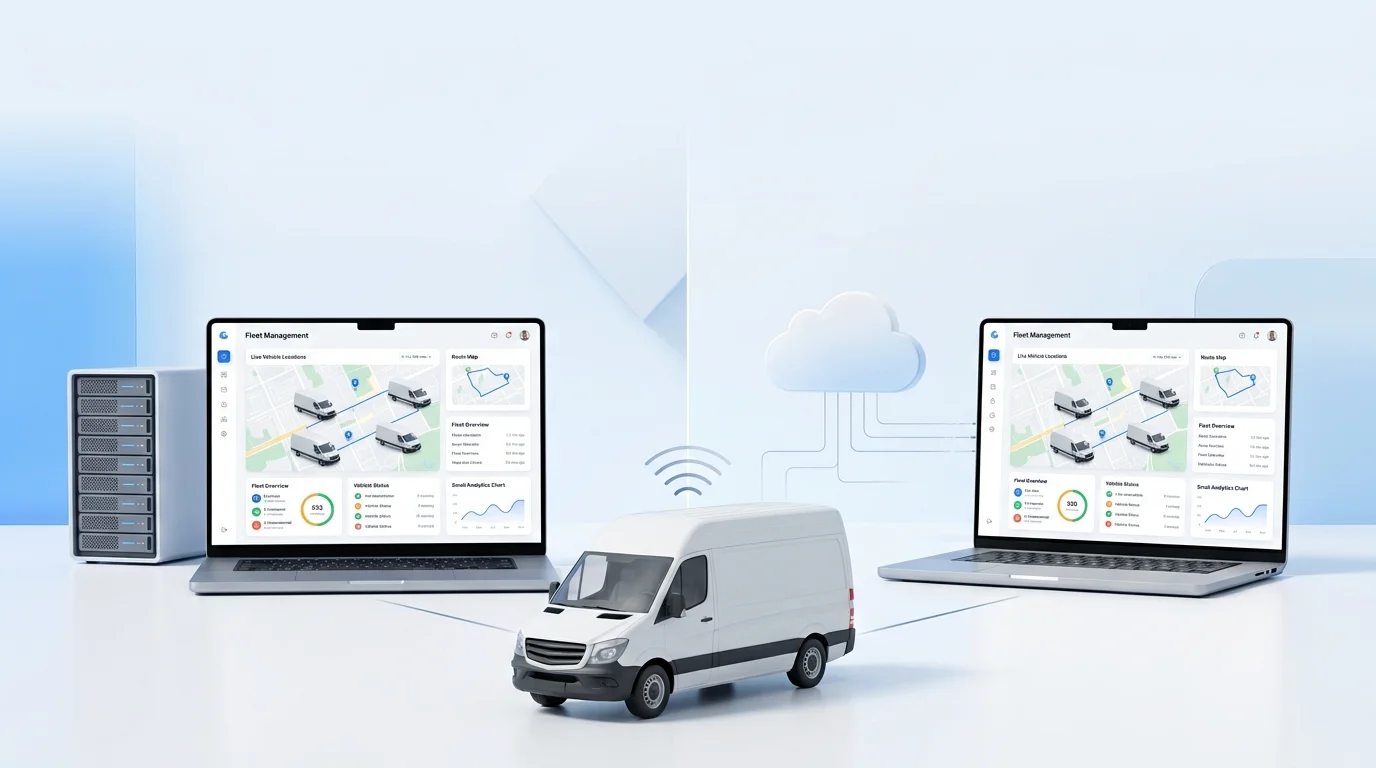
Almost every GPS tracking platform on the market is sold one of two ways: as a cloud subscription (SaaS) you rent, or as self-hosted software you install and own. The choice shapes your costs, your data privacy, your security responsibilities, and how far you can scale, so it’s worth getting right before you commit.
This guide compares self-hosted vs cloud GPS tracking across the factors that actually matter, then gives you a simple framework for deciding. For the broader case in favor of owning your stack, see our pillar guide on the benefits of self-hosted GPS tracking software.
The Core Difference
With cloud (SaaS) GPS tracking, the vendor hosts everything. You sign up, pay a recurring fee per device, and access the platform through a browser. Setup is fast and maintenance is the vendor’s problem, but your data lives on their infrastructure and your costs scale with every vehicle.
With self-hosted (on-premise) GPS tracking, you install the software on your own server or private cloud. You own the data and the deployment, usually for a one-time license plus hosting costs, in exchange for handling setup and maintenance yourself.
Side-by-Side Comparison
| Factor | Cloud SaaS GPS Tracking | Self-Hosted GPS Tracking |
| Setup speed | Minutes — sign up and go | Days to weeks — install and configure |
| Pricing | Recurring, ~$20–50/vehicle/month | One-time license + infrastructure |
| Data location | Vendor’s cloud, multiple jurisdictions | Your server, your jurisdiction |
| Security responsibility | Vendor’s | Yours (firewall, patches, backups) |
| Customization | Limited to vendor roadmap | Full — reports, workflows, branding |
| Branding | Usually vendor-branded | White-label with your identity |
| Scaling cost | Rises with each device | Mostly marginal infrastructure |
| Maintenance | Handled for you | Your team or your vendor |
| Compliance (GDPR, residency) | Depends on vendor’s subprocessors | Direct control, air-gap possible |
Cost: Recurring Fees vs. One-Time Investment
This is where the two models diverge most sharply. Cloud platforms commonly run $20–50 per vehicle per month. That’s painless for five vehicles and brutal for five hundred. Self-hosted platforms flip the model to a one-time license plus your own hosting, so once you’re past a few hundred units, total cost of ownership typically favors self-hosting. We break the numbers down in one-time license vs subscription GPS tracking.
Data Privacy and Security
Cloud platforms may route data through servers in several countries, which complicates GDPR cross-border transfer documentation. On-premise deployment addresses this directly: all routing and mapping can run behind your own firewall with no external transmission. If you operate in a regulated sector, or simply don’t want a third party holding your customers’ location data, self-hosting gives you control that SaaS can’t match. The trade-off is that security becomes your job, you own the firewalls, patches, and backups.
Scalability and Control
Cloud scales effortlessly for small and mid-size fleets, with no upfront hardware. But you scale on the vendor’s pricing tiers and can hit device caps, API limits, or feature paywalls. Self-hosting lets you provision capacity on demand, integrate freely with your own ERP/dispatch/billing, and avoid vendor lock-in entirely.
Which Should You Choose?
| Your situation | Better fit |
| Small fleet, no IT resources, need to launch today | Cloud SaaS |
| Mid-to-large or fast-growing fleet | Self-hosted |
| Reseller / white-label business | Self-hosted |
| Regulated or privacy-sensitive operation | Self-hosted |
| Multi-country operation needing data residency | Self-hosted |
| Pilot or short-term project | Cloud SaaS |
The honest summary: cloud wins on speed and simplicity for small operators; self-hosting wins on ownership, cost-at-scale, and control. Many businesses start on cloud and migrate to self-hosted once their fleet, or their compliance needs, grow.
If you’re leaning toward ownership, the next step is understanding exactly what you gain — read the full benefits of self-hosted GPS tracking software, or see how a self-hosted, white-label platform works in practice with AIQConnect’s self-hosted GPS tracking.
Frequently Asked Questions About Self-Hosted vs Cloud GPS Tracking
Is cloud or self-hosted GPS tracking more secure?
Neither is inherently more secure, but they differ in who controls security. Cloud relies on the vendor’s posture; self-hosting puts firewalls, patching, and data location in your hands, which regulated operations often prefer.
Is self-hosted GPS tracking more expensive?
Higher upfront, lower long-term. SaaS is cheaper to start but charges per device forever; self-hosting is a one-time license plus hosting, so it usually wins on total cost of ownership at scale.
Can I move from cloud to self-hosted later?
Yes. Many fleets start on a cloud subscription for speed and migrate to a self-hosted platform once they need more control, better economics, or compliance guarantees.


