
School Bus GPS Tracking: Safety, Ridership & Parent Alerts
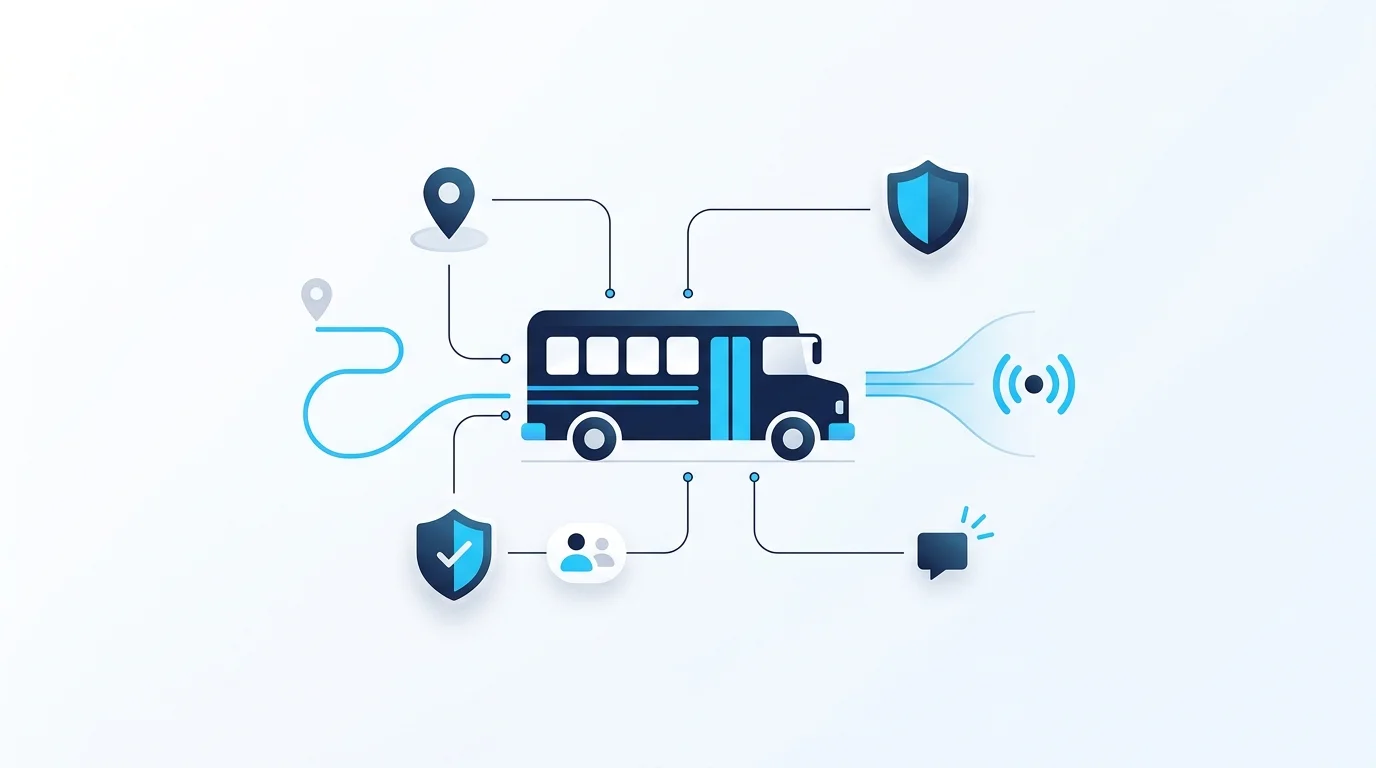
School bus GPS tracking integrates real-time tracking of all buses with student boarding data and alerts to parents to inform them where a bus is, who is on board and when it will arrive. It transforms the hushed concerns of where is the bus, did you kid get on, has it arrived or not yet when the bus is coming to collect, into a recorded fact, instead of a phone call.
The reason it is more important than normal fleet tracking is that the cargo is children and the question being asked is “where is it” and not “where is it” by a dispatcher. A delivery fleet keeps track of vehicles; a school transport operation keeps track of vehicles, and knows every pupil on every vehicle, but does not disclose that info to the parents and keeps it confidential. When GPS, student ridership and parent communication are managed safely, it’s school bus tracking on its own.
This guide will address how it works, student ridership and RFID, parent notification, route safety, considerations of data privacy, and a district’s evaluation of a platform.
Quick Answer: How Does School Bus GPS Tracking Work?
School bus GPS tracking works by combining three layers on one system:
- Live bus tracking — GPS device on each bus reports its location continually in a map that would be shown to the school and, in some instances, to parents.
- Student ridership —RFID cards (or barcode/NFC) that are scanned by students when they board and disembark from a bus, which students are on which bus, when and where.
- Parent notifications — automatic notification to parents when the bus is approaching their child stop, and when their child is boarding and/or getting off the bus.
These are surrounded by route tools and safety alerts, like stop arrival confirmation and route deviation/unscheduled stop warnings, as well as speed warnings near schools. What sets it apart from a regular fleet tracking system is its ability to track students, not just vehicles, and share information with parents, while keeping students’ data protected.
Why School Transport Needs More Than Vehicle Tracking
A school bus operation is not a delivery fleet with different cargo. Four differences make it a distinct problem:
- The passengers must be accounted for. But that’s simply not enough: a district must be aware of which students were on-boarded and disembarked and where — information that ordinary vehicle tracking fails to provide.
- Parents are the audience. Parents are the most interested group in the whereabouts of the bus and the system needs to send out messages as well as inwards to a transport office.
- Student data is sensitive. The tracking of children’s movements and the association with names is private, and in many places regulated data and how it is stored and who accesses it is more important than in a commercial fleet.
- Safety margins are tighter. Districts need to be able to identify incidents like speeding near a school zone, an unscheduled stop, or a child who is not boarding the assigned bus promptly, rather than later.
A platform designed for commercial fleets can display a bus on a map, but without student information, parent communication and student-data protection, it does not address the issues that a school transport operation has.
Student Ridership Tracking with RFID
The layer that makes bus tracking into student safety is done by student ridership tracking records that indicate which student got on and off which bus and when. The most common systems are those with an RFID card that the student puts to the door of the bus, although there are also some with bar codes and NFC.
In practice: Every student is assigned a card with his/her profile, an entrance reader at the bus entrance registers every tap when the student enters and exits the bus, every scan is time stamped and associated with the bus and location. The district receives:
- A record of who was on which bus, boarding and alighting, for every trip.
- Automatic attendance for transport, without a driver counting heads manually.
- An alert if a student does not board their scheduled bus, or boards the wrong one.
- A safety record for incident review, audits, or special-education transport requirements.
The value is accountability: a district can have a record and not a recollection to answer the question: “was this child on the bus, and where did they get off” RFID is a niche functionality that requires bus-side reader hardware and a card system to support; it isn’t something that is assumed to be available for general bus-level tracking.
Parent Notifications and the Bus App
Parent notifications are the face that’s out facing the world of the school bus tracker and for most parents, that’s the entire game: they know when the bus is coming and that their child is safe on it.
A parent app or notification system typically provides:
- Live bus location — parents can see the bus on a map as it approaches.
- Arrival ETAs — a “bus arriving in X minutes” alert so a child is at the stop in time, not waiting long in the cold or missing it.
- Boarding and drop alerts — a notification the moment their child taps on or off, confirming safe boarding and arrival.
- Delay and incident alerts — notice when the bus is running late or deviates, so parents are not left guessing.
There’s a practical plus for the school: parents will not have to call the transport office to find out where the bus is — this will depend on the district and the adoption, so check the number of calls you get, not a vendor’s. The advantage to parents is more straightforward: peace of mind, with a live view and a record. A parent app with a brand is a specialist feature as well, so double-check if a platform offers a branded parent app or SMS or third-party app.
Route Safety and Driver Monitoring
In addition to location and ridership, school bus tracking adds a layer of safety for the unique risks associated with transporting students, based on the same telematics data a commercial fleet uses, but adapted to school transportation.
The safety-relevant capabilities:
- Stop arrival confirmation — geofences at each scheduled stop for arrival and departure, confirming the route was taken..
- Route-deviation and unscheduled-stop alerts — alert if a bus departs from its approved route or stops at an unscheduled stop – alert that a district needs to know at the time.
- Speed monitoring — identifying the speed of vehicles, including identifying speeding vehicles, and notifying drivers of speeding, especially in school zones and residential areas where children may be present.
- Driver behaviour —harsh braking, acceleration and cornering scored per driver; driving style carries children, not freight! Our driver behaviour monitoring– Coaching & Scoring Guide looks at the coaching & scoring side.
These make the bus’s telematics more of a safety record that a district could act on and be proud of, rather than data looked at only after an incident.
Student Data Privacy: A School-Specific Responsibility
The ability to track children’s movements and the ability to connect them to names creates sensitive data and the handling of it is a requirement specific to school transport which a commercial fleet is not required to undergo in the same manner.
In the United States student records are set forth in FERPA — a federal law that governs student records in specific — as well as other jurisdictions have their own student-data and general privacy rules. The following are general information and not legal advice, and a district will need to verify its own obligations, but two points for any platform selection:
- Who holds the data, and where. A district and parents should be able to ask themselves a question about student movement data on a vendor’s cloud. A self-hosted platform also enables the district or its provider to retain that data on their own infrastructure, making the data-governance issue less complicated.
- Who can access it, and for how long. Student data access controls and retention policy is more important than commercial fleet data access controls and retention policy, and this should be considered as part of the evaluation, not just an afterthought.
The key here is that student-data sensitivity is not necessarily a requirement for a deployment model, it’s dependent on how the platform is used, but it should be a first-order consideration during deployment and configuration of a school transport platform.
School Bus Tracking in AIQ Connect
AIQ Connect is a self-hosted GPS tracking and fleet platform on your infrastructure. It can be used for school transport and correlates with the vehicle-and-safety layer, with student-ridership and parent-app features to confirm:
| School transport need | Platform consideration |
| Live bus tracking | Real-time location of every bus on one map |
| Stop arrival (geofencing) | Geofences at stops for arrival/departure confirmation |
| Route safety | Route-deviation, unscheduled-stop and speed alerts |
| Driver behaviour | Harsh-event and speeding scoring per driver |
| Data control | Student and route data on infrastructure you control |
| RFID student ridership | Confirm — RFID scan-on/scan-off needs reader hardware and student-card management; verify support or expect specialist tooling |
| Parent app / notifications | Confirm — a branded parent app and parent alerts may require specialist tooling or integration; verify before relying on them |
| Attendance / SIS integration | Confirm — integration with student information or attendance systems should be verified for your district |
Self-hosted deployment means that bus and route data is maintained on infrastructure the district or its provider controls, and as such, is relevant to the student-data-privacy point above.
If a school transport solution is required. AIQ Connect’s advantages for school transport include real-time GPS tracking, stop geofencing, route-safety alerts and driver behaviour on your own infrastructure. The student-specific layer – RFID ridership scan-on/scan-off, branded parent app, student-information-system or attendance integration are specialist school-transport features; identify which AIQ Connect features are available in your district and where your district does not have them, expect to have to use a dedicated school-transport platform or integration for that layer. AIQ Connect is not intended to replace legal counsel regarding student-data requirements.
How to Choose a School Bus Tracking Platform
Evaluate against six criteria specific to school transport:
- Student ridership — does it support RFID (or barcode/NFC) scan-on/scan-off with alert to student if they do not get on their bus if ridership is required?
- Parent communication — Use parent app or notifications (live location, arrival ETAs, boarding alerts) or use a third party.
- Route safety alerts – stop arrival confirmation, route-deviation and unscheduled-stop alerts, speed monitoring near schools.
- Student-data privacy – where student data is stored, who can access it, retention controls, and fit with your jurisdiction’s requirements.
- Driver safety — driver-behaviour monitoring (because the fleet is transporting children).
- Integration – if you need ridership to feed official records (information or attendance systems).
Pilot a representative route, using the actual parents and student ridership workflow you plan to use, to ensure that the student and parent-facing features are correct before rolling out.
Frequently Asked Questions
How does school bus GPS tracking work?
Each bus is equipped with a GPS which is constantly reporting its location, displayed on a map for the school and frequently for parents. Some systems also record RFID student ridership (students tap a card as they board and disembark, so it’s known which students were on which bus) and parent notifications for arrival of ETAs and boarding alerts. These are surrounded by features designed to keep drivers safe on the road, including stop confirmation, deviation alerts, and speed alerts near schools.
What is student ridership tracking?
Student tracking records are used to see which students boarded and exited which bus, as well as when, typically by tapping an RFID card against the bus door. It provides a district with a record of everyone on each bus, automatic attendance on each bus, and notifies the district if a student does not get on their scheduled bus. It’s also a specialist feature that needs reader hardware on the bus and a student-card system, so there is no need to confirm that.
How do parents track the school bus?
By way of a parent application or notification system connected to the bus tracking system. Parents will usually be able to see the bus on a map, be given an ETA (“bus is arriving in X minutes”) and be alerted when their child boarded the bus or got off. Some platforms have a parent-facing application; others use SMS or a third party app; check the parent-facing application in particular when assessing.
Does school bus tracking use RFID?
Student ridership – many school bus systems use RFID for this; barcode and NFC are used as well – a RFID card which a student taps at the bus door to log boarding and alighting. Automatic attendance with RFID indicating who was on which bus and automatically notifying parents. It is different from GPS tracking of the bus itself: The GPS is used to track the bus, the RFID to track the students on the bus.
Is student tracking data private and safe?
Viewed as sensitive, as student location and ridership records are personal data about minors and subject to regulation (in the U.S. for example, FERPA). Its safety level is determined by the operation of the system, such as data storage, user access, and data retention. With a self-hosted platform, a district maintains control of student information, and it is the district’s responsibility to ensure that it meets its own jurisdiction requirements, not those of any particular platform.
How does GPS tracking improve school bus safety?
It includes a number of safety features: arrival confirmation (to ensure the route was followed), notification of bus departure from the route/schedule, bus speed in school zones, driver behaviour scoring (due to transporting children). In addition to the student ridership, it also provides the ability to intercept a child who is not getting onto their designated bus. This creates a safety record that a district can use, rather than just access following a collision.
Can one platform track buses and manage student ridership?
Some can, but two different capabilities. Basic GPS tracking of the bus is a fundamental component of any fleet platform; other features include specialist school-transport solutions such as RFID student ridership, integration with parent apps and attendance. Ensure that a single platform has the coverage for both layers or that you have a dedicated school-transport platform or a tracking platform that has integration capabilities.
What should a district look for in school bus tracking software?
For any student that must be recorded in official records, ensure student ridership (RFID scan-on/scan-off with not-boarded alert); parent communication (app or notifications with ETAs and boarding alert); route-safety alerts (stop confirmation, deviation, speed near schools); student-data privacy (storage location, access controls, jurisdiction fit); driver-behaviour monitoring; integration with student information system. Test with actual parents and routes prior to rollout.
Running School Transport?
AIQ Connect offers real-time bus tracking, stop geofencing and route-safety alerts and driver-behaviour monitoring on infrastructure you control — relevant to the student-data-privacy considerations in this guide. Do a demonstration of the student-ridership and parent-app features your district needs during a demo.
Book a free AIQ Connect demo →
Related reading: School Bus Tracking Software · Driver Behaviour Monitoring · Fleet Management Solutions · What Is Self-Hosted GPS Tracking Software?


